BUYER GUIDE · 2026-10-12 · BY DAN SUN, MARKETING DIRECTOR · REVIEWED BY YONGFENG JIAO, STRUCTURAL ENGINEER
Racking for AMR & Goods-to-Person Robots: The Tolerance Guide for Integrators
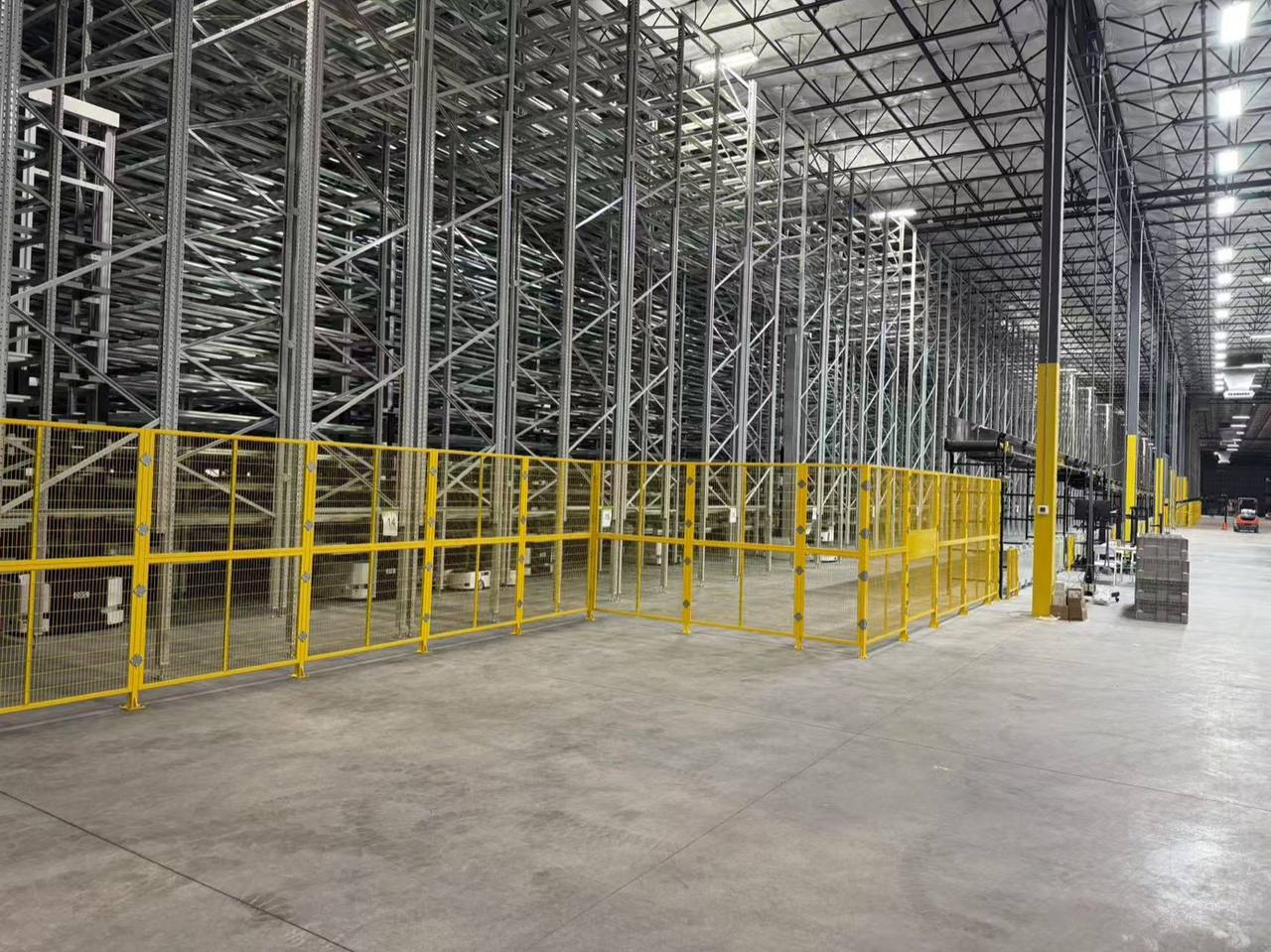
Robots are less forgiving than forklifts
A forklift driver compensates for a beam that sits 5 mm off; a robot cannot. AMR and CTU systems navigate to coordinates. Every pick face must be where the fleet map says it is — across every aisle, every level, and every batch of racking components delivered over months of phased rollout.
This is why robot-compatible racking is a distinct manufacturing discipline, not a marketing label on standard shelving.
Robot-compatible racking OEM — how we work with integrators →
The specifications that matter
- Hole pitch & pattern — upright perforation at the pitch your shelving/beam system requires (50 mm and 75 mm patterns are the industry norms), held to tight positional tolerance over full upright length.
- Level flatness and elevation repeatability — tote-support rails and beams must meet the robot's pick-face elevation budget at every position.
- Beam deflection under load — deflection beyond the design limit shifts pick geometry; automated systems should specify deflection control per FEM 10.2.02 / EN 15512, verified by test.
- Dimensional consistency across batches — a rollout of 500,000+ positions ships in dozens of containers over months. Components from batch 1 and batch 40 must interchange without recalibration.
- Interface documentation — rail profiles, clearances and load data exchanged with the robot OEM's engineering team, under NDA where required.
What batch consistency actually looks like
It starts upstream: cold-formed profiles rolled from consistent steel (we roll from Baowu steel), cut to length with sub-millimeter tolerance on automated lines, punched on dedicated tooling, and powder-coated on a fully automatic line whose film thickness (60–80 µm) does not eat the tolerance budget.
Then it is QC discipline: first-article inspection per batch, gauge checks on hole position and rail straightness, and container packing that protects machined geometry in transit. This is the unglamorous work that keeps a 200-robot fleet calibrated.
Working with JISE as an integrator
We manufacture to the robot OEM's interface drawings — from any major AMR brand — and our delivered base includes over 2 million multi-shuttle and CTU tote racking locations for the overseas projects of leading global integrators, including 890,000+ and 670,000+ positions in two Polish mega-projects, 450,000+ in Korea, 220,000+ in the UK and 140,000+ in Australia.
Cooperation models: white-label manufacture under your brand, direct supply to your end clients with installation by our overseas crews, or frame-only supply where you handle integration. Engineering liaison is direct with our structural team — English-language, drawing-level, no sales layers in between.
Frequently asked questions
Why does hole pitch matter for robot racking?
A 50/75 mm pitch lets shelf levels match tote heights in fine increments, recovering vertical density across thousands of locations — but only if the pitch is positionally true over the full upright length. Positional error accumulates and shifts every pick face off the fleet map.
How much beam deflection can a robot tolerate?
Far less than a forklift driver. A loaded beam sagging a few millimetres moves every tote on it below its mapped position, and a robot gripper has no judgement to absorb the difference. Verify deflection against FEM 10.2.02 / EN 15512 serviceability limits — and against the robot OEM's tighter interface requirement where it applies.
What locks tolerances before mass production?
First-article inspection. The first production frames are measured against the interface drawing — hole pitch, level heights, plumb — and volume production starts only after sign-off. Batch consistency is then verified lot by lot, so frames from month 12 interchange with frames from month 1.
Get a project quotation within 48 hours.
Send us your warehouse dimensions, pallet spec and target location count — our engineers reply with a layout proposal and budgetary price.