FEM 9.832 — Tolerances, Deformations and Clearances in Automatic Small Parts Warehouses, Explained
By Dan Sun, Marketing Director · Technically reviewed by Yongfeng Jiao, Structural Engineer · JISE Intelligent Storage
What FEM 9.832 actually is
FEM 9.832 — 'Basis of calculations for S/R machines: tolerances, deformations and clearances in automatic small parts warehouses (not silo design)' — is a FEM Section IX document that quantifies how much the rack, the floor, the rails and the load-handling device of an automatic small parts (miniload) warehouse are each allowed to deviate, and how those deviations add up at the rack compartment opening.
Its sibling document, FEM 9.831-1, covers the same problem for unit-load pallet high-bay warehouses served by stacker cranes. If your project stores totes, cartons or trays with a rail-guided miniload crane stabilized by an upper guide rail, FEM 9.832 is the relevant reference; pallet systems point to FEM 9.831-1, and shuttle-based pallet systems to FEM 10.2.19.
Why tolerances are the whole game in small parts storage
A miniload load-handling device enters a rack compartment with clearances measured in millimetres. The total error budget is a stack: floor slab flatness and settlement, floor-rail and upper-guide-rail alignment, crane positioning repeatability, rack manufacturing tolerances, rack deformation under load, and the unit load's own dimensional spread. FEM 9.832 assigns permissible values to each factor — surface/foundations, floor slab, floor rail, upper guide rail, unit load, storage location, S/R machine and rack structure — and provides the calculation method (Section 7) that combines them into entry and compartment clearances.
The practical consequence: in a miniload project, the rack is not 'just steel'. It is one half of a machine interface. If rack uprights lean a few millimetres more than budgeted at the top of a 15 m miniload, the telescope faults, the aisle blocks, and the whole system waits for a service engineer.
The allocation of responsibility — the part buyers should insist on
The document's declared aim is that 'the values for individual system components will result in clearly defined levels of responsibility in the event of interface problems.' In plain terms: when the crane supplier and the rack supplier blame each other after commissioning, FEM 9.832 provides the measuring stick that settles the argument — including a measurement and acceptance form (Annex B) for recording as-built tolerances at handover.
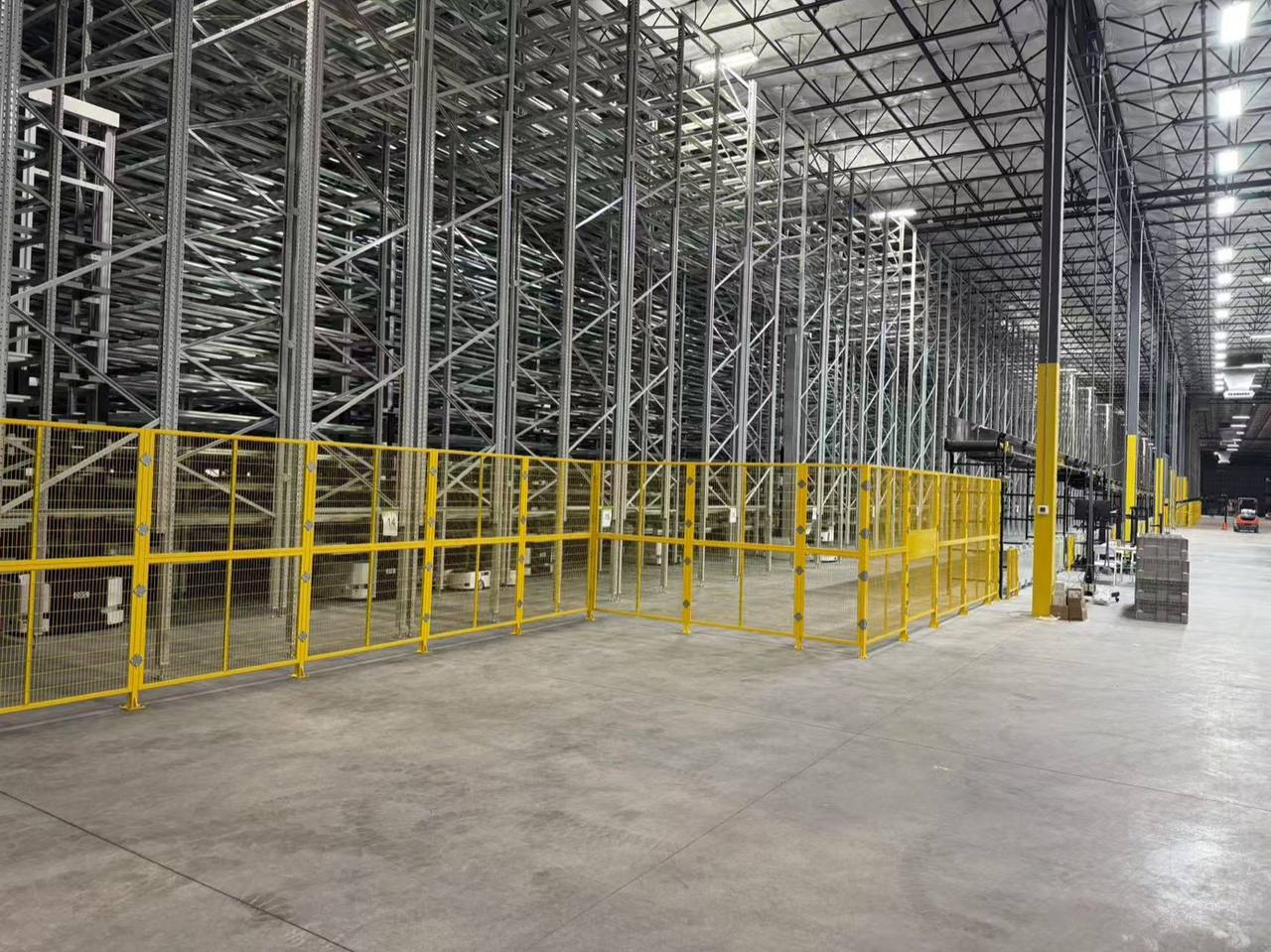
This is why experienced buyers write FEM 9.832 (or an equivalent project-specific tolerance specification) into the contract, and why JISE manufactures robot-compatible and miniload racking directly from the integrator's interface drawings — with more than 2 million tote locations delivered for overseas automation projects. The same interface philosophy governs our work with AMR and CTU systems.
Questions to ask a small parts racking supplier
Which tolerance regime governs your rack manufacture and installation — FEM 9.832, FEM 9.831-1, or a project-specific specification agreed with the crane supplier? What upright straightness and position tolerances do you guarantee, and how are they verified before handover? Is there a signed measurement and acceptance record per aisle?
A supplier who treats these as surprising questions has never commissioned an automated aisle. Tolerance capability is manufacturing capability: roll-forming precision, drilling/punching accuracy and installation discipline decide whether the error budget closes.
Where FEM 9.832 sits in the standards family
FEM 9.832 handles the machine interface; it does not replace structural design. The rack structure itself is designed to EN 15512 (or FEM 10.2.02), with seismic actions where required (seismic racking design), and the crane itself under EN 528 safety requirements. A compliant miniload project names all of them: structure, interface, machine safety.
JISE publishes its compliance evidence — test reports, certificates and project documentation — on the Quality page for buyers who want to verify rather than trust.
Frequently asked questions
Is FEM 9.832 legally mandatory?
No — FEM documents are industry guidelines, not law. In practice they are written into contracts as the agreed technical reference, and European miniload projects routinely name FEM 9.832 as the tolerance basis. Its value is that it makes responsibility measurable when interface problems appear.
What is the difference between FEM 9.831-1 and FEM 9.832?
FEM 9.831-1 covers tolerances, deformations and clearances for unit-load (pallet) high-bay warehouses with stacker cranes; FEM 9.832 covers automatic small parts (miniload) warehouses that are not of silo design. The structure is the same; the loads, compartment sizes and clearances differ.
Does FEM 9.832 apply to AMR or CTU robot racking?
It was written for rail-guided S/R machines, but modern tote-handling robots face the same millimetre-level interface problem. Most robot-compatible racking projects adopt a project-specific tolerance specification built on the same philosophy — quantified per-component tolerances plus an acceptance measurement at handover.
Who is responsible when a miniload crane faults at the rack face?
Responsibility follows the error budget: floor slab to the civil contractor, rails to their installer, crane positioning to the machine supplier, rack geometry to the rack manufacturer. FEM 9.832 exists precisely to make this allocation objective — provided as-built measurements were recorded at acceptance.
See it in practice: Robot-compatible racking OEM — 2M+ tote locations delivered →
More from the standards library.
Get a project quotation within 48 hours.
Send us your warehouse dimensions, pallet spec and target location count — our engineers reply with a layout proposal and budgetary price.